Warré plans
Warré methods
Warré modifications
Warré precursors
Groups / Fora
Google
e-group
Biobees.com
forum
Abbé Warré's book
Beekeeping for All:
Gilbert Brockmann published an article in the German beekeeping magazine ADIZ (1) which describes a hive and beekeeping method in use in Japan. After studying the website of one of the beekeepers concerned, Syouichi Morimoto (http://www.h6.dion.ne.jp/~kansatu/index.html), contact was made to ask more about it. It emerged that the beekeeping system Syouichi Morimoto uses is a traditional one. It was used in Japan during the Edo period (A.D.1586 to A.D.1911). It is very similar to Warré's.
The bee that Syouichi Morimoto uses is Apis cerana japonica. Compared with Apis mellifera, it is less prone to disease, forms smaller colonies and gives correspondingly less honey per colony (4 to 14 kg). Syouichi Morimoto's hive is divisible/expandable, comprising boxes of internal dimensions 240 mm (footprint) by 150 mm high, i.e. 60 mm less on both dimensions compared with Warré boxes.
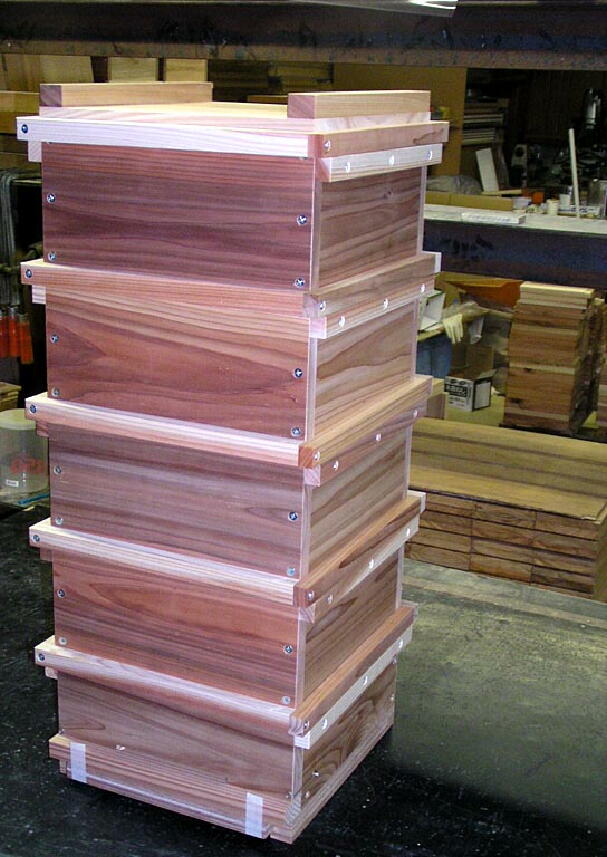
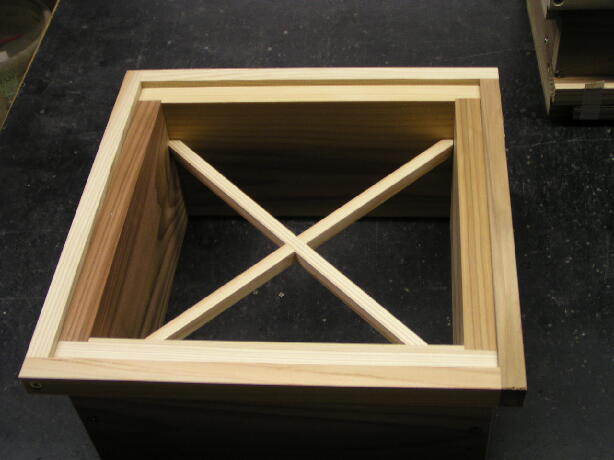
Syouichi Morimoto's hive (left) and detail of hive-body box containing spales to stabilise comb.
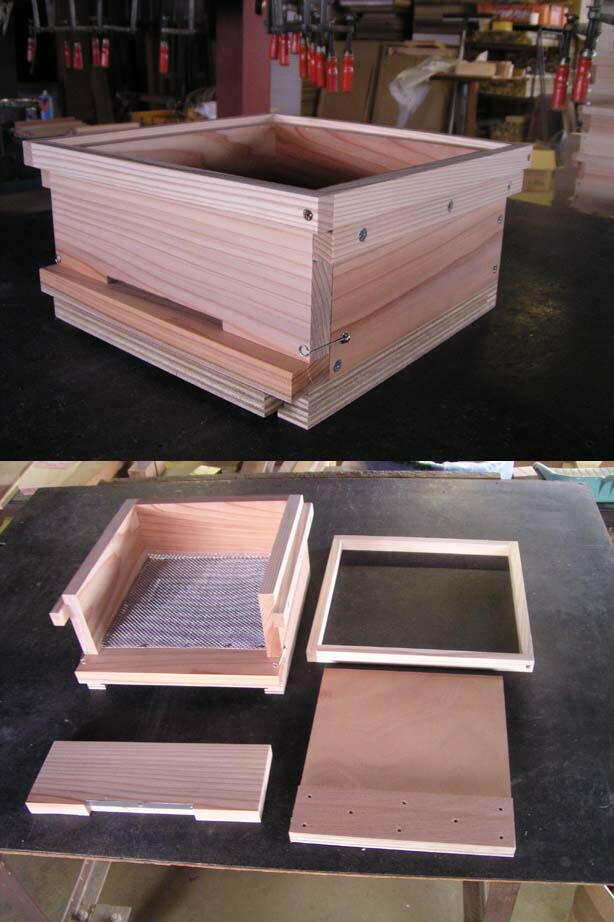
Above: Mesh floor unit with front opening to insert feeder
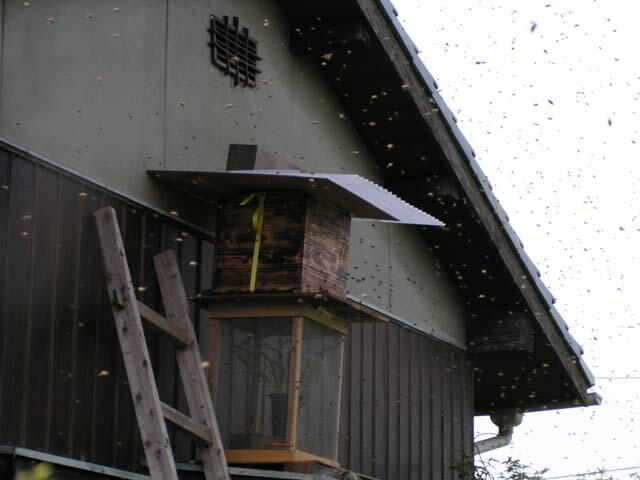
Apis cerana swarms readily. Here (above) a swarm is lured with a bait hive placed high up. The plant, Cymbidium floribundum (kinryouhen in Japanese), in the wire mesh cage below the hive is the swarm lure. The hive is also rubbed with beeswax round the entrance inside and out, as is a framework (or mesh) inside the top of the hive on which the bees start the comb.
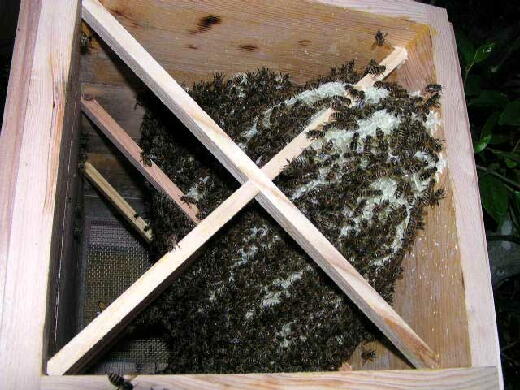
The swarm has settled in and is drawing natural comb (view from below). This photo illustrates the function of the spales. In the Warré hive, top-bars take the place of spales by providing a fresh start to comb at the top of each hive-body box. New boxes are added at the bottom, as with the Warré hive. Likewise the honey is harvested by removing one or more boxes at the top. Syouichi Morimoto says that he harvests in spring and autumn.
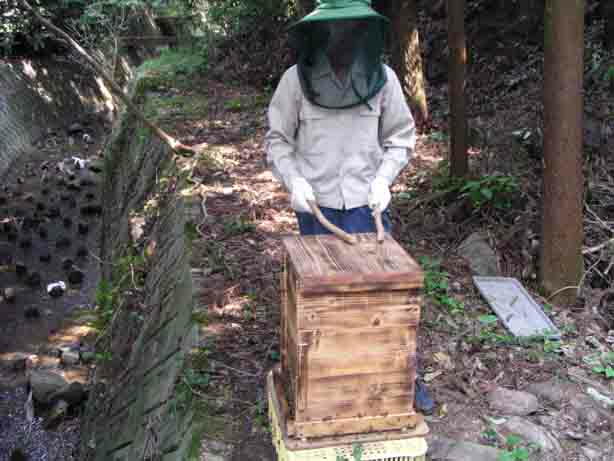
Preparing for harvest by driving the bees down with drumming on the lid. Warré recommends smoking the bees down for harvesting from his hive.
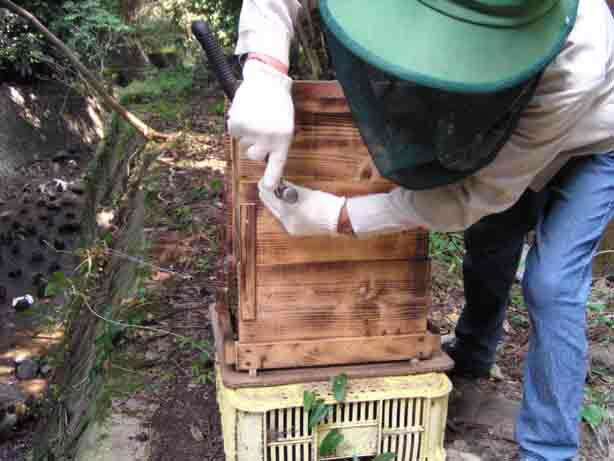
Inserting a thin wedge to lift the honey box slightly.
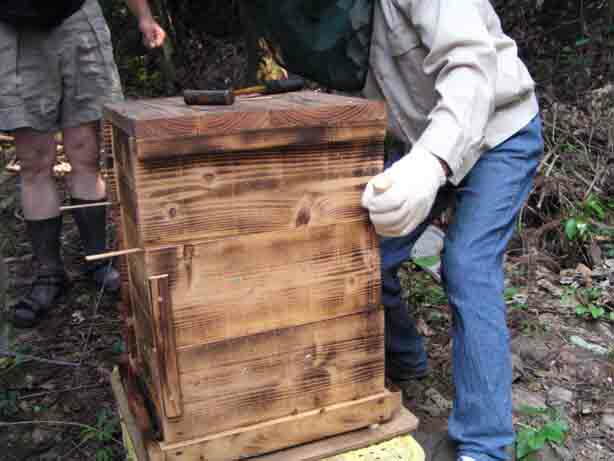
Cutting through comb below the top box with piano wire. Pfarrer J. L. Christ also recommends harvesting this way, but Warré advises easing the top box free by slight twisting. This is possible in the Warré hive because the top-bars in it interrupt the comb and any bridges are easily sheared. Also, if in a Warré hive the brood nest is unexpectedly near the top, there is a risk of damaging the queen by using wire.
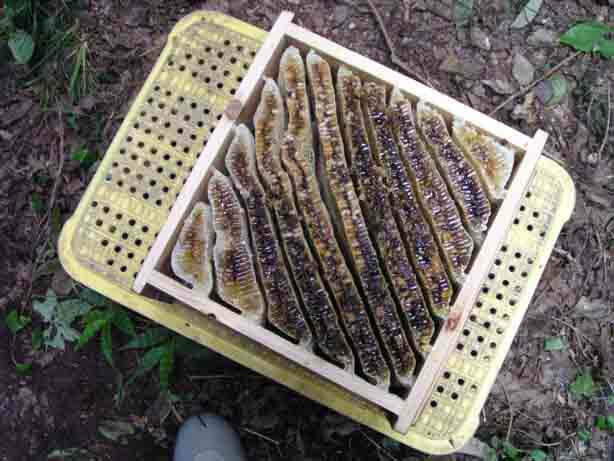
Natural comb filled with honey in the top box that has been removed.
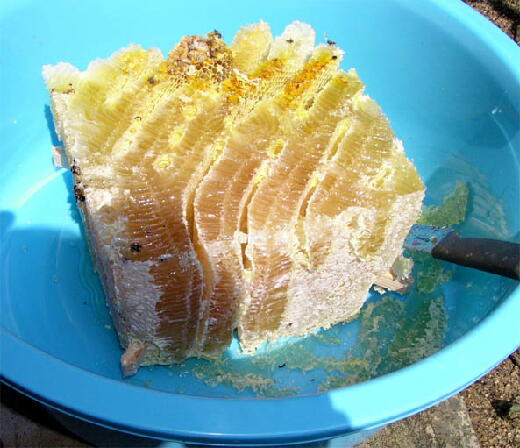
Honeycomb with spales still embedded.
A method of fixing the spales
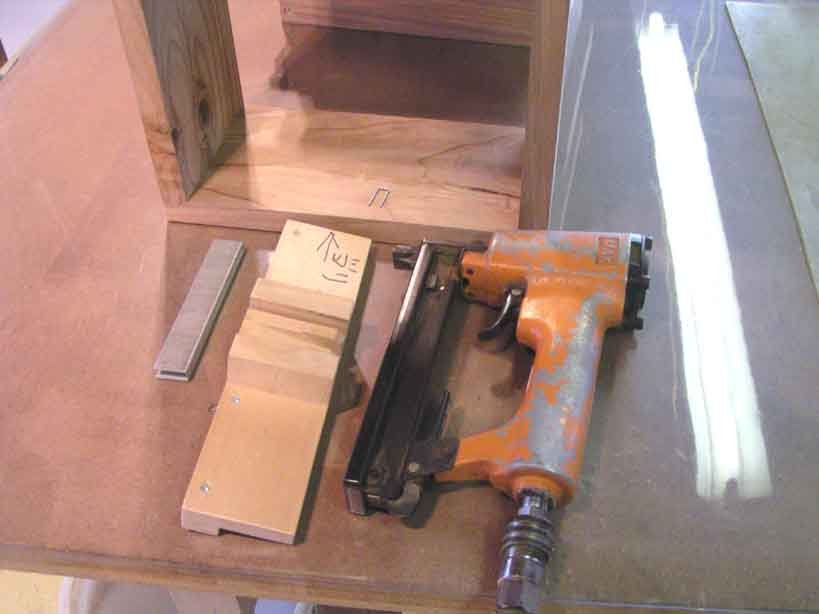
The tools including a strip of heavy-duty staples (left).
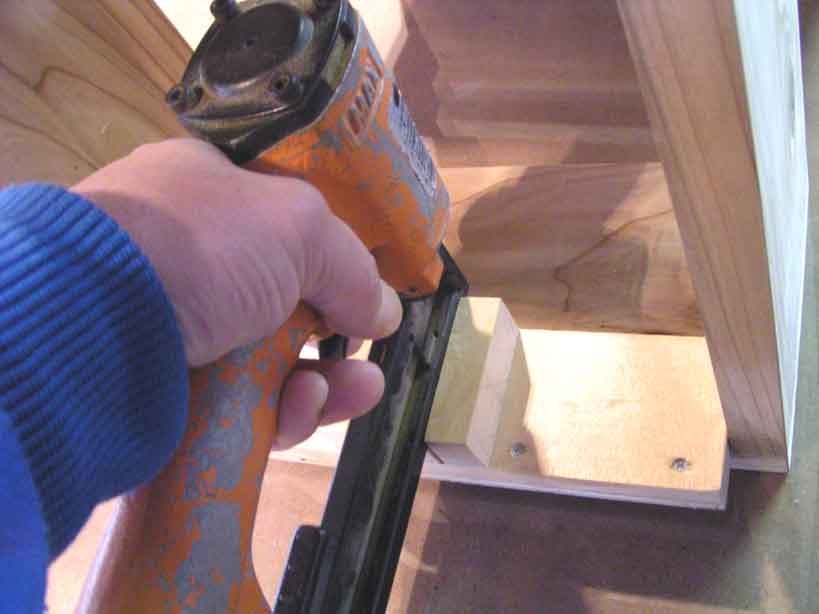
Drilling the holes for a staple.
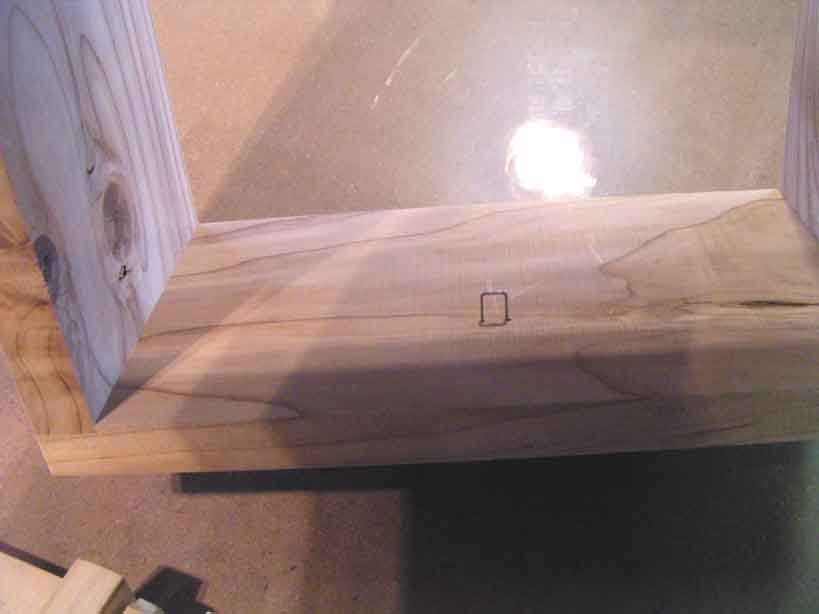
Staple inserted in holes.
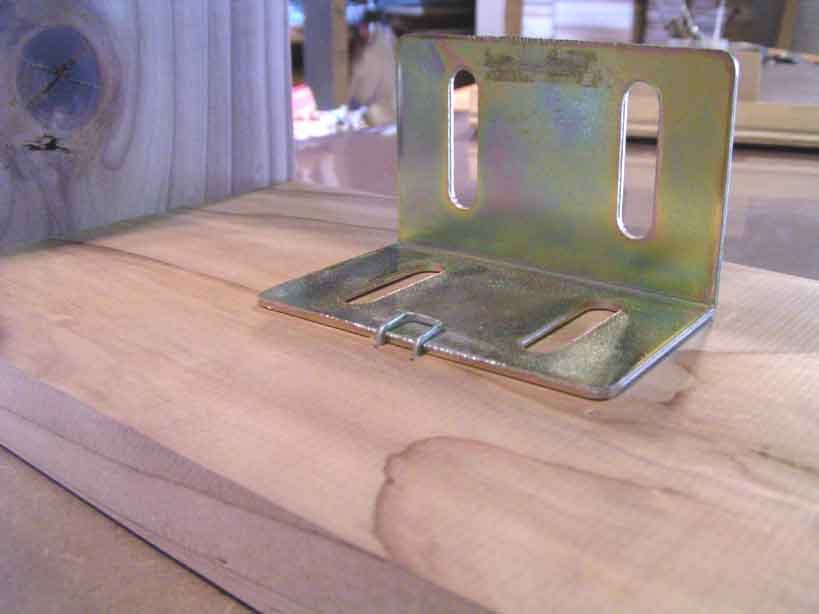
Bending a staple over a former.
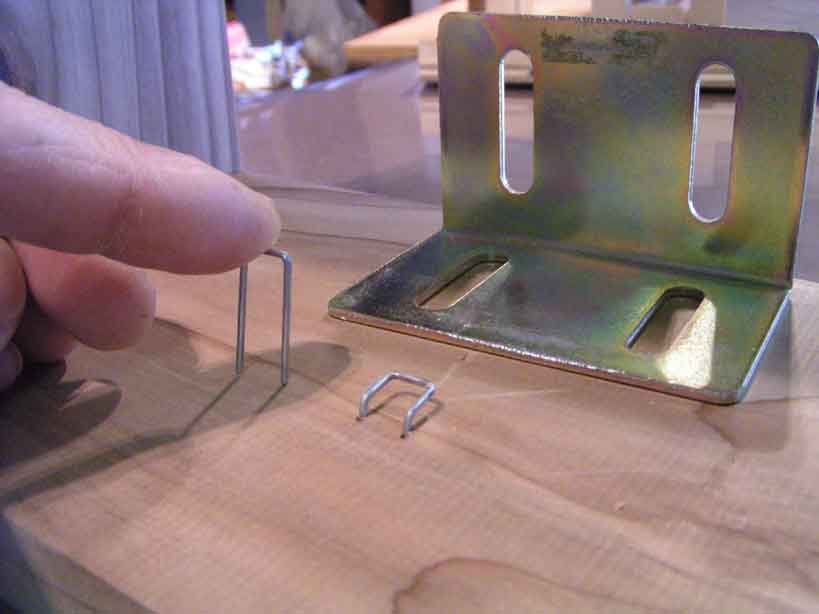
Staple before and after bending.
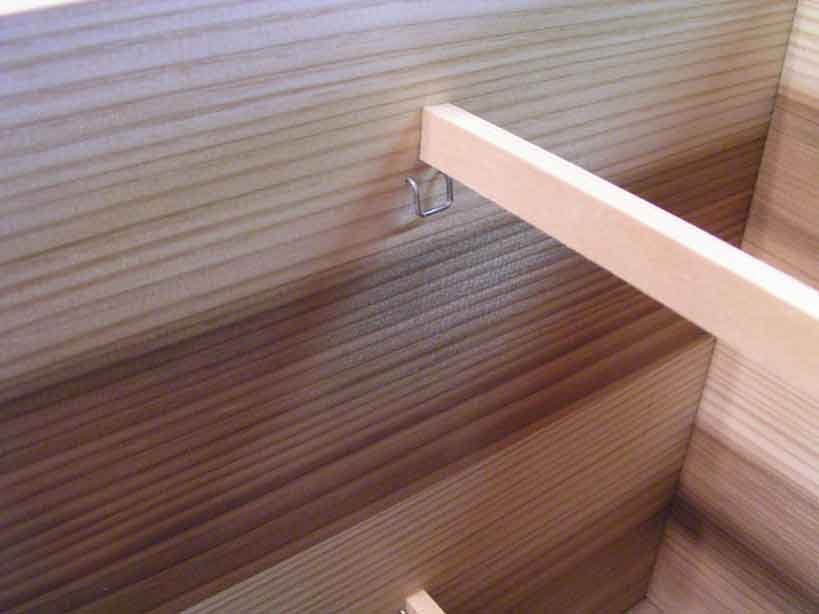
Inserting a spale.
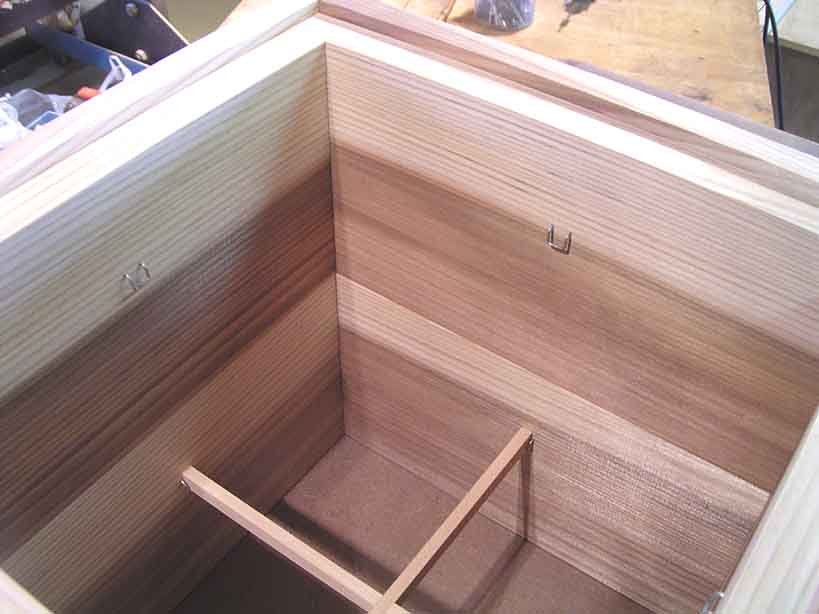
One box completed.
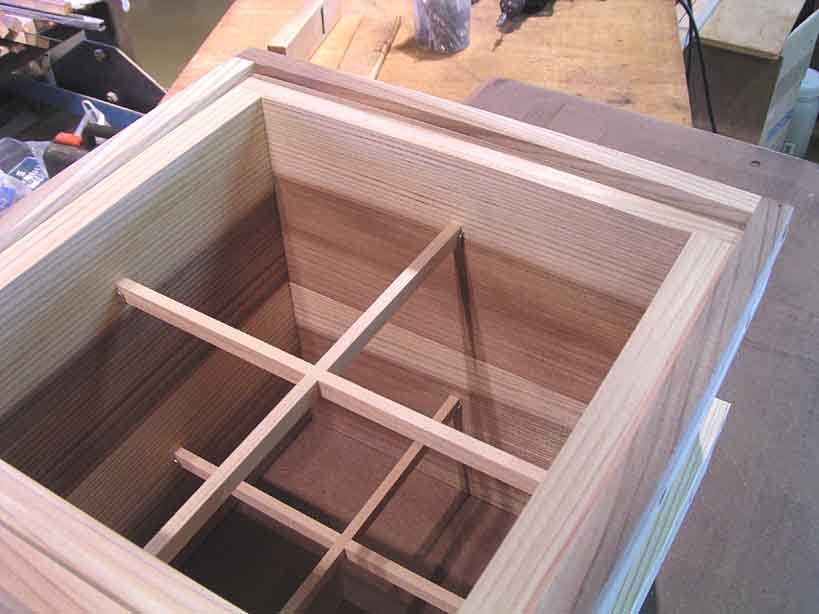
Two boxes completed.
More pictures on Syouichi Morimoto's web site at http://www.h6.dion.ne.jp/~kansatu/index.html where he can be contacted.
See also the Warré-like hives without top-bars of another
beekeeper in Japan:
http://to.totomo.net/1028.htm
http://to.totomo.net/2062.htm
http://to.totomo.net/2066.htm
Detailed resource on the Japanese 'pile box hive': https://www.japan-natural-beekeeping.org/
Videos of traditional Apis cerana beekeeping in Japan
A Japanese beekeeper has uploaded to Youtube under the pseudonym 'mituro36' ninety-three videos of beekeeping in Japan, among which are four of Warré-like beekeeping almost identical to that described above. The videos illustrate nadiring; covering cracks with tape; using wire to separate boxes; using a hair drier to clear box of bees prior to harvesting it; design of box with steel spales, free comb and something resembling a Warré roof and quilt; honey extraction using crushing, straining and finally pressing with an interesting looking press that looks as if it has been built for the purpose. The four parts are at:
Part 1: http://www.youtube.com/watch?v=IZldnd9wMLU
Part 2: http://www.youtube.com/watch?v=c_pKEn5WtLM
Part 3: http://www.youtube.com/watch?v=r3rX-gsm-M4
Part 4: http://www.youtube.com/watch?v=AgzsaTgl_44&feature=related
A fifth video shows the design of the hive and assembly:
http://www.youtube.com/watch?v=41NFuIVG3EI
More videos on Apis cerana beekeeping:
Method of construction:
https://www.youtube.com/watch?v=QbC1hFIO14A
The use of a defensive cage in front of the hive entrance and
concerted movement from the bees to threaten Giant Hornets at:
http://www.youtube.com/watch?v=sHXZ5hS7u5Y&feature=mfu_in_order&list=UL
A traditional hive with frames instead of spales at:
http://www.youtube.com/watch?v=dMTjEbwbono&feature=BF&list=ULTVZzh_HvA3g&index=24
Bees swarming at:
http://www.youtube.com/watch?v=f1lfzRmTEO8&feature=BF&list=ULTVZzh_HvA3g&index=23
Use of hive lift with Apis cerana hive
https://www.youtube.com/watch?v=9zvQZvW3y4Q
Reference
(1) Brockmann, Gilbert (2007) Mit Bienen bei Freunden -- Begegnung mit einem Freizeitimker aus Japan. ADIZ/db/IF 6/2007, pp. 14-15.